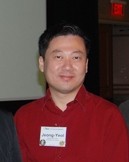
Professor Jeong-Yeol Yoon
Jeong-Yeol received his B.S., M.S. and Ph.D. degrees in Chemical Engineering from Yonsei University, Seoul (South Korea) in 1992, 1994 and 1999, respectively, under the guidance of Professor Woo-Sik Kim, in collaboration with Professor Jung-Hyun Kim, where he worked primarily on polymer colloids. He received his second Ph.D. degree in Biomedical Engineering from University of California, Los Angeles in 2004, working on lab-on-a-chip and biomaterials, under the guidance of Professor Robin L. Garrell. He joined faculty of the University of Arizona in August 2004, and currently holds split home appointments in Department of Biomedical Engineering (primary) and Department of Agricultural & Biosystems Engineering (secondary). He also holds a joint appointment in BIO5 Institute. He is currently directing Biosensors Lab. Dr Yoon is a member of IBE, ASABE and SPIE, and was Councilor-at-Large for IBE for 2010 and 2011 calendar years. He has been elected as President of IBE in 2013, and served as President Elect in 2014, President in 2015, and Immediate Past President in 2016. He currently serves as Editor-in-Chief for Journal of Biological Engineering (IBE) and Editorial Board Member for Scientific Reports (Nature Publishing Group), and has served as Associate Editor for ASABE journals and Editorial Board Member for Resource Magazine (ASABE). Dr Yoon is currently Co-Director of NIH-funded Cardiovascular Training Grant at the University of Arizona.
For more information, see Professor Yoon's lab website.
 Professor Raj R Rao
Professor Rao received his B.E. (Hons) and M.Sc (Hons) concurrently in Chemical Engineering and Biological Sciences, respectively, from Birla Institute of Technology and Sciences (BITS), Pilani, India. He then went on to earn his M.S in Biotechnology from the University of Texas, and his Ph.D in Biological Engineering from the University of Georgia. He currently serves as Professor in Biomedical Engineering at the University of Arkansas, Fayetteville. Prior to that (2005-2016), he served on the faculty at Virginia Commonwealth University, in the Department of Chemical and Life Science Engineering, School of Engineering. He is a valued member of the Society for Biological Engineering, Biomedical Engineering Society, Institute of Biological Engineering, and International Society for Stem Cell Research. He is an elected Fellow of the American Institute of Medical and Biological Engineering (AIMBE) and elected Fellow of Biomedical Engineering Society (BMES); and served as the President of the Institute of Biological Engineering (2022-2023). Professor Rao has authored over 60 peer reviewed articles in a wide range of journals.
For more information, see Professor Rao's web page.


